
Most dining table bases you find online come in two forms. One of them is a fixed size you buy exactly as it comes and built for a standard round or square top. The other form is a kit you assemble yourself, with parts to sand, finish, and put together on your own.
A custom dining table base is an entirely different option. This is sized to match the dining table top you already have, whether that’s a reclaimed slab, a stone or glass top you bought separately, or a top you’re still designing. The base is the structure underneath that holds the top up, keeps it steady, and gives the table its shape. For a dining table, the base does as much for the look of the room as the top does.
Common Table Base Styles
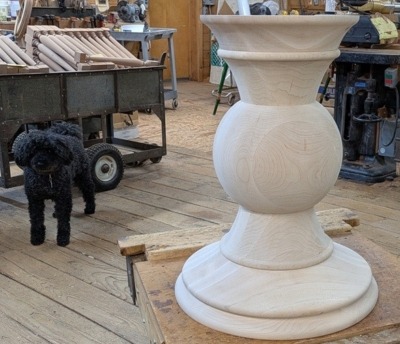
A solid, single-column base is the most familiar style to most. One turned post rises from the floor to a wide top plate which gives the table an open feel underneath with no corner legs to work around. It suits round and square dining tables well, and it’s a strong fit for a smaller dining space. Here is an example of a solid, single-column base. Without legs at the corners, chairs can be pulled up anywhere around the table, which makes it easier to seat an extra guest or move around the table during a meal.
A segmented base is made from several pieces glued together before being turned, rather than shaped from one solid post. This method allows for larger diameters and, in some cases, a mix of wood species or grain patterns. It tends to suit a more decorative or formal dining table. See a segmented turned wood base for an example.
For bigger or heavier tops, a larger-scale base carries the extra weight without looking undersized next to the table. This style works well under oversized dining tables, thick slab tops, or any other tabletop where a standard-size base would look out of proportion. See our large wood table bases for examples.
You can stain or paint any style of base to match the rest of your table or room once it arrives.
Single Pedestal or Double Pedestal Base?
Tables with a round or square top and six seats or fewer typically do well with a single pedestal. Longer tables seating six to ten, or tables with an oval or rectangular top, often need a double pedestal, two separated columns that distribute the weight of the top across two points instead of one.
As a general guideline, this is more about the shape and length of your table than the exact seat count, so we talk through the right configuration once we know your tabletop.
How Big Should a Dining Table Base Be?
There’s no single correct size for a dining table base, which is part of why fixed-size options often look wrong under a real tabletop. In general, a base is roughly half to two-thirds the width of the top it supports. A heavy solid wood or stone top calls for a sturdier base. A lighter top can carry a narrower one without looking unbalanced.
Round and square tops generally do well with a single central base. Longer rectangular or oval dining tables often need a wider base, or support at two points along the length. This can keep the table from feeling unstable at the ends.
These are just starting points. The right size depends on your specific tabletop, so we work out the details with you directly rather than asking you to match your table to a size.
Why a Custom Base Beats a Fixed-Size Base
A base sized for your tabletop is planned around it from the start. That avoids a stock base that looks too narrow for the top, or a heavy slab sitting on a base that wasn’t sized to carry it. Wood species can be matched to the tabletop for cohesion or chosen to contrast it on purpose.
We recently supplied a pedestal base for a kitchen island overhang, sized and shaped for a stone top no off-the-shelf base would have suited. Read the full kitchen island pedestal base case study.
For a closer look at a dining table specifically, our dining table case study covers a base supplied for a customer’s dining table from start to finish.
What to Send Us for a Quote
Getting a quote started is simple. Send us:
From there, we’ll talk through the right style and proportions for your table and walk you through next steps. Contact our team.
Table Base or Table Legs?
If you already know you want individual legs at the corners instead of a central base, that’s a different product with its own considerations. See our wood table legs for that option.
Ready to Start Your Dining Table Base?
A custom base is sized around the table you have, not the other way around. Send us your tabletop’s information and we’ll help you figure out the right style and size for it.
If you already have both a base and a top picked out and want to make sure they’ll work well together, our table base pairing guide covers that next.
Request a free quote to get started.