
What to Know at a Glance
A Simple Definition of a Finial
A finial is a decorative or ornamental piece that marks the very top or end of an object. In simple terms, it’s a “cap” or finishing touch that makes something look complete. The word “finial” comes from the Latin finis, meaning “end,” because a finial usually signifies the end point of an object.
Finials are often added to everyday items and structures to make them more attractive. For example, you can find them on furniture, curtain rods, lamps, and even on the tops of buildings.
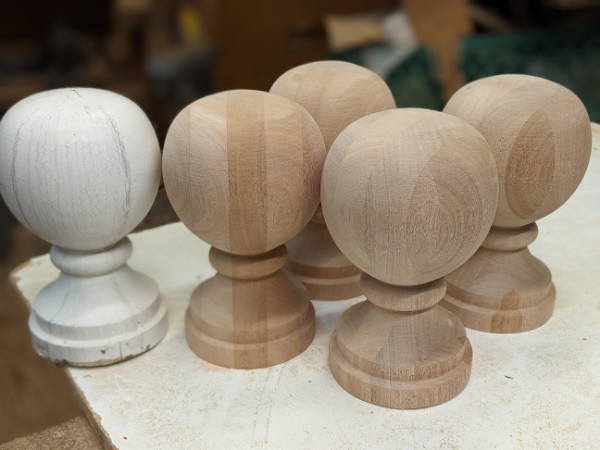
Custom Mahogany Finials – Matched to Customer Sample for Architectural Projects
Handcrafted mahogany finials, reproduced from a customer sample for custom woodworking projects.
Common Types of Finials & Where They’re Used
These wood pieces come in many shapes and sizes, and they serve different purposes around the home and in architecture. Some are very simple, while others are elaborate and eye-catching. No matter the type, all of them act as a finishing detail that makes an object look complete and decorative.
Finials can be found in all sorts of places. Below are some common types and where you might see them.
Architectural versions are usually the most noticeable type of finial. As an example, the famous Taj Mahal in India has a bronze finial perched on the top of its main dome. It sits over 30 feet tall and was originally made of gold, serving as the “crown” of the building’s design. It doesn’t hold anything up or cover anything; it simply shows off the importance of that building’s highest point. In general, they often become a signature part of a design.
Finials vs. Caps vs. Knobs – What’s the Difference?
It’s easy to confuse finials with other end pieces like caps or knobs, but they do have differences. A cap is usually a plain cover for the end of a post or rod – its job is mostly to protect the end or give it a finished look. Caps tend to be smooth, flat, or simple in design and don’t draw much attention. For example, a flat wooden plug on the top of a fence post is a cap.
A knob, on the other hand, is usually a functional handle or a simple rounded piece that you grab or turn (like a door knob or a drawer knob). Knobs can be decorative, but they are primarily made to be touched and used. Finials are different because their main purpose is to decorate and enhance the appearance of the object’s end point. You typically don’t grab or turn a finial (except perhaps a lamp finial when unscrewing it). In fact, the same stair post might have a newel cap if it’s plain, but an ornate one is called a newel finial if it’s highly decorative.
To summarize, a finial is like an ornamental crown for an object, whereas caps and knobs are usually simpler and more about function than flair.
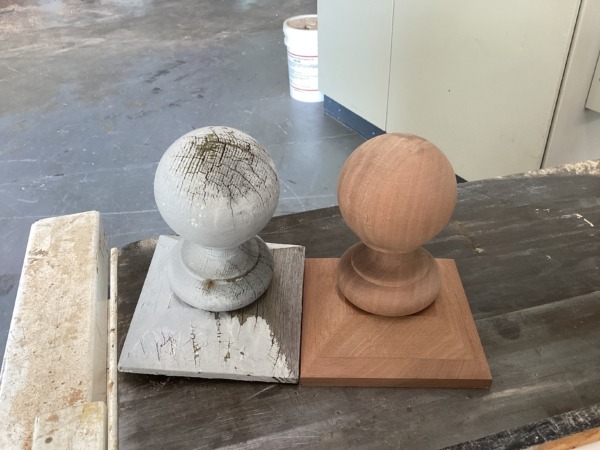
Sapele Newel Post Cap Reproduction Beside Aged Sample
Reproduced sapele newel post cap shown next to the original customer-supplied sample for comparison.
What Are Finials Made Of?
As we mentioned earlier, finials can be made from various materials depending on what you need them for and how you want them to look. Below are a couple of common materials and where they are often used.
Can These Pieces Be Customized?
For designers, contractors, and production buyers, the finial is often the detail that has to be exact. Arnold Wood Turning supplies custom wood finials turned to match drawings, samples, or specified dimensions.
Ordering a custom wood finial typically starts with a drawing, sample, or photo of the design you need. Arnold Wood Turning supplies matching components for restoration projects, repeat production runs, and large-scale architectural builds.
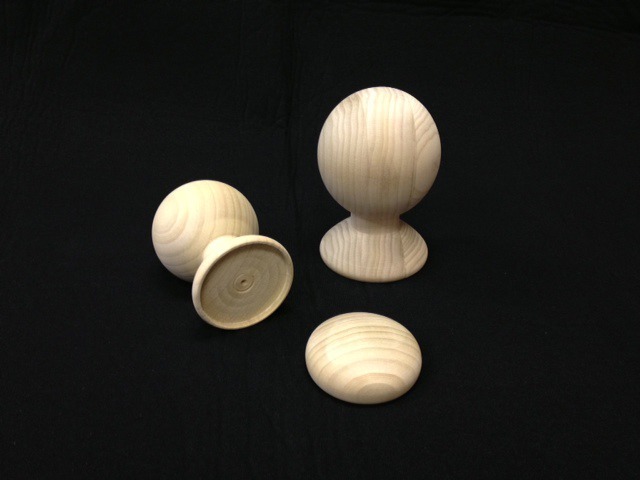
Custom Poplar End Cap Finials
Small poplar ball finials and one poplar cap finial designed for custom architectural and furniture applications. These finials can be customized in different sizes and wood species.
Final Thoughts: Small Details, Big Impact
Finials are often the finishing detail that signals real attention to craft. Whether the application is a residential staircase, a period restoration, or a production run of flag pole components, the right wood finial brings the design together. Arnold Wood Turning supplies custom wood finials for architectural and commercial projects of all scales.
Let’s Get Started on Your Custom Order
If you’re sourcing custom wood finials for a production run, architectural project, or residential renovation, reach out to us. We’ll talk you through each step and provide you with a free, no-obligation estimate. Arnold Wood Turning has supplied custom wood components for architectural and production projects since 1919.