
For manufacturers specifying wood components, birch is one of the more practical choices on the market. It offers a strong strength-to-weight ratio, machines well on lathes and CNC equipment, and is available at a lower cost than maple or oak without a significant drop in performance.
This guide breaks down the strengths, limitations, and best applications of birch wood, and where Arnold Wood Turning supplies it for production runs.
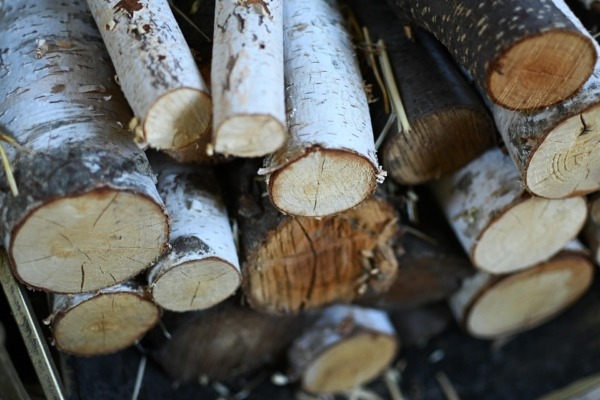
Birch Wood Logs Prepared for Manufacturing
Birch logs are a reliable raw material for bulk manufacturing of handles, dowels, and turned wood parts.
What Is Birch Wood?
Birch is a hardwood that comes from the birch tree, which grows widely across North America and parts of Europe. Common species used in manufacturing include yellow birch, white birch, and paper birch. It is known for its pale color, which ranges from creamy white to light brown, and its smooth, fine grain that gives a clean, modern look.
Because it is a relatively abundant species and grows quickly, birch wood is more cost-effective than many other hardwoods. For businesses looking for a strong yet affordable material, birch provides a balance between performance and price.
Key Properties of Birch Wood
Birch wood has several qualities that make it valuable in manufacturing. It is strong for its weight, with a Janka hardness rating around 1,260 lbf. This is harder than poplar but not as hard as maple. It’s tough enough for handles and turned parts without being overly heavy.
Birch machines well on lathes and CNC equipment, though sharp tools are important to avoid burning. Its fine grain is great for smooth finishes and even staining for both painted and natural looks. Birch is widely available in the United States, which keeps costs lower and ensures supply consistency for large orders.
Strengths of Birch Wood in Manufacturing
Birch wood has several strengths that make it an attractive option for manufacturers:
These strengths combine to make birch a practical option for companies that need quality components at scale.
Limitations of Birch Wood in Manufacturing
While birch has many advantages, it also has some challenges. Birch is not naturally resistant to decay, meaning it may not be the best option for outdoor use unless properly treated or sealed. If it’s not dried carefully, it can warp or twist. This can cause production delays or wasted material.
During machining, especially at high speeds, birch has a tendency to burn, which means sharp, well-maintained tools are a must. Compared to maple, birch has slightly less dimensional stability, meaning it can expand and contract more with changes in humidity. Manufacturers should weigh these limitations against the cost savings and performance advantages birch provides before making any decisions.
Best Uses of Birch Wood in Manufacturing
Birch wood is used in many industries, and it fits well into the types of products we supply at Arnold Wood Turning.
Common applications include the following:
Birch Wood vs. Other Manufacturing Woods
When deciding on materials as a manufacturer, you often compare birch to other popular hardwoods.
Finishing & Secondary Operations with Birch
Birch accepts finishing operations well. Its even grain produces consistent stain results across production runs, and it glues strongly and holds fasteners without splitting, which matters for assembly-line efficiency.
CNC machines and lathes handle birch effectively, but tool sharpness must be maintained to avoid burning or rough cuts. These qualities make birch wood an adaptable choice for those needing both efficiency and flexibility in their finishing processes.
How to Source Birch Wood for Production Runs
In addition to finding a good price, sourcing birch wood for manufacturing is also about the grade of the lumber, the kiln-drying process, and the consistency of supply.
Moisture content, in particular, affects whether the wood will remain stable during machining and after installation. Lead times can vary depending on volume, so planning ahead for bulk runs is absolutely essential. Arnold Wood Turning supplies birch wood components that meet production specifications, with consistent quality across bulk orders.
Birch Wood Components from Arnold Wood Turning
Arnold Wood Turning has over a century of experience supplying high-quality birch wood components. Available components include tool handles, dowels, balusters, columns, newels, and custom turned parts.
Arnold Wood Turning supplies birch components for bulk production programs, including orders requiring thousands of identical pieces. We understand how to specify it properly and deliver it reliably.
If you are planning a project that requires birch wood components, Arnold Wood Turning can help you identify the right spec and supply what your production run requires. Reach out today for a free, no-obligation quote.
Frequently Asked Questions (FAQs) for Birch Wood
- All
- Birch Wood – Applications & Uses
- Birch Wood – General Information
- Birch Wood – Limitations & Challenges
- Birch Wood – Properties & Performance
Birch is widely used for tool handles, dowels, turned parts, and architectural products like balusters and columns.
Birch can burn during high-speed machining if tools aren’t sharp. It also may expand or contract more with humidity changes. Consult with a professional wood turner for more information.
Not without treatment. Birch is not naturally resistant to decay or moisture. It should be sealed, coated, or otherwise treated if used outdoors.
Yes. It allows for smooth finishes, consistent staining, and excellent paint adhesion. Birch wood is adaptable for multiple product lines. Have a specific product in mind? Let us know and we’ll see how we can help.
Birch has a Janka hardness rating around 1,260 lbf. It’s harder than poplar but softer than maple and oak, providing a middle ground that balances strength, workability, and affordability.
Yellow birch, white birch, and paper birch are usually the most common. These species grow abundantly in North America and are reliable for large-scale manufacturing needs.
Birch is recognized for its light color, smooth grain, and high strength-to-weight ratio. It’s a cost-effective solution compared to maple or oak, yet still machines well and delivers consistent finishing results.