
How a Large-Scale Mahogany Balustrade System Came Together
When a project needs hundreds of matching exterior wood balusters in a custom profile, finding the right supplier for the job is not always simple. The large assortment of catalog products you’ll come across rarely match what an older or architecturally detailed home needs. And when the quantities get large, the stakes are higher. A bad batch or a supplier who oversells and underdelivers can set a project back by weeks or even months.
But the right supplier can make all the difference.
Arnold Wood Turning supplied a large exterior balustrade system, from custom profile approval through full production, for a residential project that required 220 paint-grade mahogany balusters and 13 sections of matching top and bottom rail.
The Project at a Glance
The scope of this project was significant. The client needed a complete exterior balustrade system to match the rest of the property. This meant custom-turned balusters were required, not off-the-shelf options that were “close enough”. It also meant the rail system had to be built to match, running across multiple sections at three different lengths.
Here is what the order covered:
Balusters
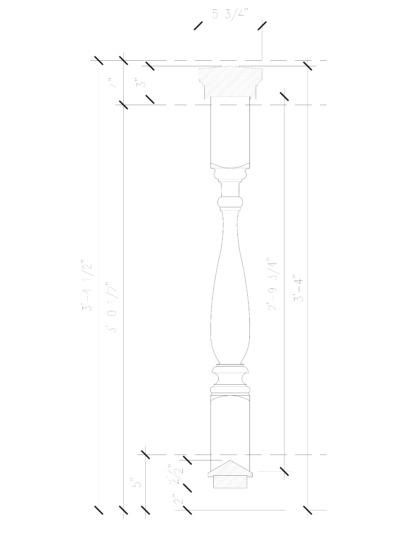
220 custom-turned paint-grade mahogany balusters at 3-1/2″ wide by 33-3/4″ tall, turned to a specific vase profile with square top and bottom sections. Each baluster also required a custom-cut angle on the bottom to match the pitch of the bottom rail.
Top Rail
Mahogany top rail, paint-grade, at 3″ high by 5-3/4″ wide, supplied across 13 sections in three lengths: four at 8 feet, two at 10 feet, and seven at 12 feet.
Bottom Rail
Mahogany bottom rail, paint-grade, at 2-1/2″ high, supplied across the same 13 sections in the same three lengths.
This was not a small order and it was not a standard profile. Getting it right required a clear read on the project and process from the start.
Why Mahogany for Exterior Use?
Mahogany is a strong choice of species for exterior wood components, especially when the finished product will be painted. It resists expansion, contraction, and warping, which can be accelerated by outdoor exposure. It also holds paint well when called upon to do so.
For a project like this, where 220 pieces need to look identical once painted and installed, consistency from piece to piece is not optional. Mahogany delivers that in a way that softer or more variable species do not.
Paint-grade designation means the wood is selected for surface quality and dimensional accuracy rather than grain appearance. For exterior balusters that will be primed and painted, it is the right choice. It keeps the material cost focused on what matters for the finished result.
Starting With a Sample, Not an Assumption
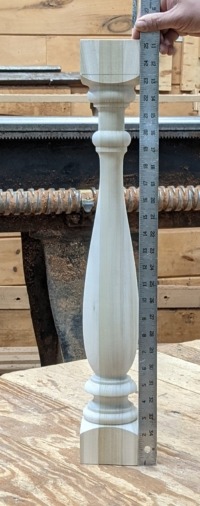
Before any mahogany balusters were turned, Arnold Wood Turning arranged for a poplar sample to be produced and photographed for client review. The purpose was to confirm the profile geometry (square block dimensions on the sample were adjusted for the final mahogany production run) before committing the full order to mahogany. The client approved it, and production began.
On a 220-piece order, getting the profile wrong and finding out at delivery is a big problem. Building sample approval into the process means both sides see exactly what is being produced before anyone is committed to the full quantity. It removes the guessing and the risk.
The approved profile is a classic vase-style turn with an elongated body, square block sections at the top and bottom, and a gradual transition between turned and square geometry. It’s period-appropriate, which is what this kind of property requires.
The Custom Bottom Cut
One detail worth mentioning is that each of the 220 balusters needed a custom-cut angle at the bottom to seat correctly against the bottom rail. This is not a standard feature and it requires knowing the rail pitch and cutting each piece accordingly before they ship.
Getting this cut right across 220 pieces is a production detail that catches some suppliers off guard. It requires communication, not just manufacturing. Arnold Wood Turning built it into the order from the beginning, so it was not a surprise to anyone later on.
What the Installed System Looks Like
Installed across the full exterior of the property, the system holds its profile. The spacing is consistent, the lines are level, and the balusters suit the surrounding architecture.
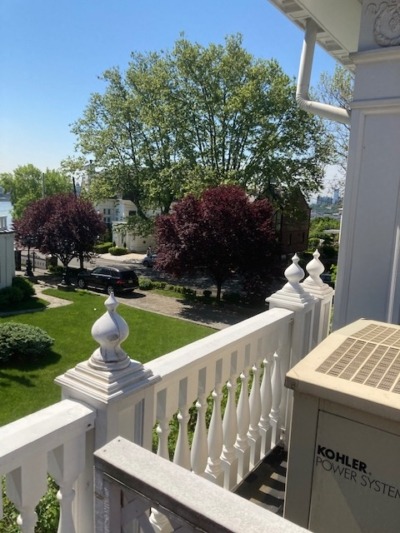
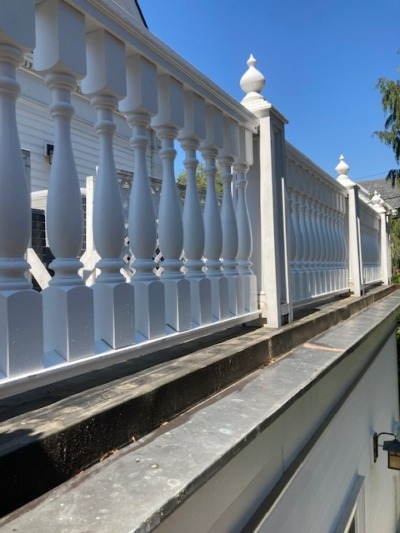
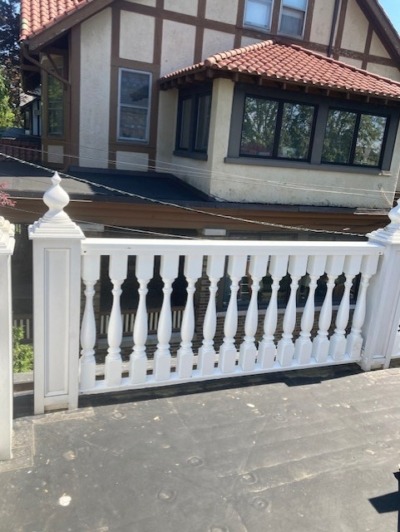
What the photos do not show is the coordination that made it work: confirming the profile, accounting for the angled bottom cut, coordinating rail lengths across 13 sections, and managing the full production run to arrive ready for installation.
This kind of coordination is easier when you are working with a small, family-owned team where one person knows your project from the first conversation through the delivery.
The Rail System
The rails can be an afterthought in projects like this, but they shouldn’t be. A baluster that fits the architecture and a rail that does not match will undermine each other. Here, the top and bottom rails were specified in mahogany to match the balusters, in the same paint-grade material, and supplied in the specific lengths needed for each section of the run.
Supplying rail in three different lengths across 13 sections is not complicated when it is planned correctly. It becomes a problem when it is not, and the installer ends up cutting pieces on site to fit gaps that were never measured precisely. On this project, the lengths were specified in the order and the material was supplied to match.
What This Kind of Project Requires
Exterior balustrade projects of this size run into the same problems repeatedly when the sourcing is not handled correctly. Some of these problems could include:
Each of these is avoidable with adequate preparation and working with the right partner.
Working With Arnold Wood Turning on Custom Exterior Balusters
Arnold Wood Turning supplies custom-turned exterior balusters in a range of species, profiles, and dimensions. Paint-grade mahogany orders like this one are common, as are white oak, poplar, sapele, and other species suited to exterior applications depending on the project’s finish requirements and budget.
For projects with specific profiles and where the installation has unique requirements, like an angled bottom cut, those details are built into the order at the start.
If you have a project that needs custom exterior balusters in a specific profile, species, or dimension, request a quote and include as much project detail as you have. We’ll take it from there.